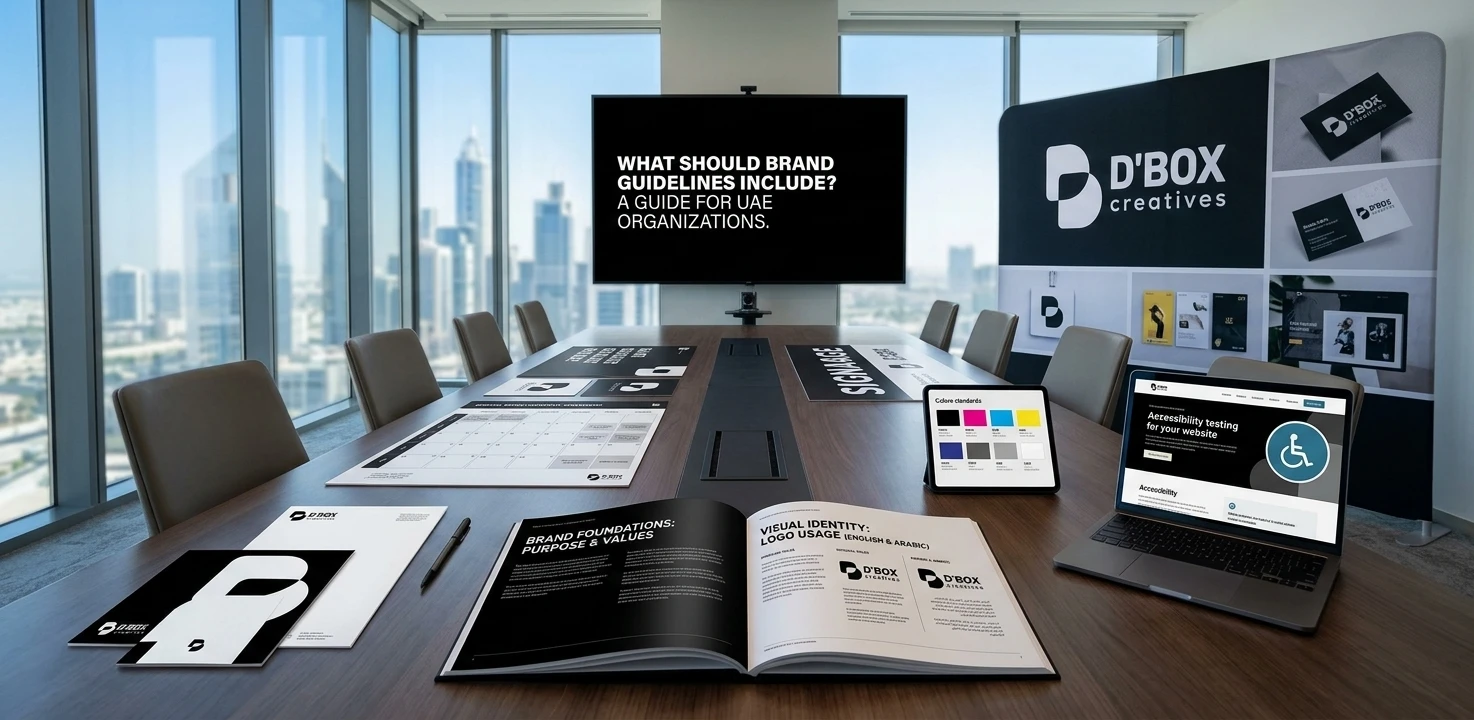
What Should Brand Guidelines Include?
A Guide for UAE Organizations
A new brand usually looks its best on launch day. The real test comes six months later, when a sales team builds its own presentation, a supplier prints signage, and a new hire designs a social post. Whether the brand still looks like itself at that point depends almost entirely on one thing: its brand guidelines.
Good guidelines turn a brand from a set of design files into a system anyone can use. So what should brand guidelines include? Here's what we believe every organization in the UAE needs, and what separates guidelines that get used from ones that sit in a shared folder.
What are brand guidelines?
Brand guidelines are the rules and examples that explain how a brand should look, sound, and be applied. You'll also hear them called a brand book or brand style guidelines. The name matters less than the purpose: helping everyone who represents the brand make the same decisions, without needing to ask the designer every time. They protect the investment you've made in your brand. Without them, small inconsistencies build up until the brand no longer feels like one organization.
Start with the brand foundations
The best guidelines don't open with the logo. They open with why the brand exists. A short section on purpose, positioning, values, and personality gives people context for every rule that follows. When someone understands what the brand stands for, they make better decisions in situations the guidelines never anticipated. Keep this section brief and clear. A single page that people actually read is worth more than a long manifesto they skip.
Who are brand guidelines for?
Guidelines aren't only for designers. Marketing teams, HR, sales, communications, and external suppliers such as printers, event companies, and web developers all represent the brand. Write with all of them in mind. Use plain language, explain the reason behind important rules, and make it obvious where to find the right files. If a supplier can follow the guidelines without calling you, they're doing their job.
The visual identity essentials
This is the core of most visual identity guidelines, and it should be practical rather than decorative.
Logo : Clear logo guidelines show every approved version: primary, secondary, horizontal, stacked, and icon-only, plus versions for light and dark backgrounds. Define the clear space around the logo, the minimum size, and, just as importantly, clear examples of what not to do, such as stretching, recoloring, or adding effects.
Color : List the primary and secondary colors with their values for print and screen, including CMYK, RGB, and HEX. Explain how much of each color to use, because proportion is often what makes a brand recognizable.
Typography : Specify the typefaces, weights, and sizes for headings, body text, and captions. If the brand fonts aren't available everywhere, name a safe alternative for everyday documents and emails.
Imagery and iconography : Describe the photography style, with examples of what fits and what doesn't. Include the icon set and any illustration or graphic elements, with rules for how they're used.
Layout. Show the grids, margins, and spacing that hold the brand together across formats, from social posts to large-format print.
Bilingual rules for UAE brands
For most organizations in the UAE, brand guidelines have to cover Arabic and English properly. This is where many guidelines fall short. It isn't enough to provide an Arabic version of the logo. The guidelines should explain how both languages work together. That means showing the approved bilingual logo lockups, pairing Arabic and Latin typefaces with matching sizes and weights, and explaining how layouts change for right-to-left reading. It also helps to show side-by-side examples of the same item in both languages, so teams can see the balance they're aiming for.
Tone of voice
A brand isn't only how it looks. It's also how it sounds. A tone of voice section describes the brand's personality in writing, with a few principles and before-and-after examples. Include guidance for both Arabic and English, since a direct translation rarely captures the same tone.
Show the brand in use
Rules are easier to follow when people can see them applied. Include examples of real touchpoints such as stationery, presentations, social media, the website, signage, and event materials. These examples often become the most-used pages in the whole document. Add digital-specific guidance too: how the brand appears on the website and in apps, social media profile images and templates, and email signatures. And include accessibility standards, such as minimum color contrast and text sizes, so the brand works for everyone.
Make the guidelines easy to use
The most detailed guidelines are useless if nobody opens them. A few things make a big difference:
- Provide templates. Ready-made templates for presentations, letterheads, and social posts do more for consistency than any rule.
- Keep it accessible. A searchable PDF or online version that anyone can find quickly is better than a heavy printed book.
- Give it an owner. Someone inside the organization should be responsible for answering questions, approving exceptions, and keeping the guidelines up to date.
- Update it. Brands evolve. New channels and touchpoints appear. Review the guidelines regularly so they stay relevant.
Common mistakes to avoid
The most common mistakes we see are guidelines that only cover the logo, rules with no examples, Arabic treated as an afterthought, and documents so long that nobody reads them. Another is creating guidelines once and never updating them, so teams start working around them.
How D'BOX Creatives builds brand guidelines
D'BOX Creatives is a Dubai-based branding and creative agency with capabilities across brand strategy, brand creation, brand experience, and brand activation. Since 2006, we've worked with organizations across the region from our offices in Dubai, Abu Dhabi, Riyadh, Cairo, and Montreal, and our work has been recognized at WBDS and the Kyoto Global Design Awards.
We create brand identity guidelines as working tools, not presentation pieces. They start with the brand's foundations, cover Arabic and English properly, and include the templates and examples teams need every day. If your brand needs guidelines that people will actually use, let's talk.
Frequently Asked Questions
What should brand guidelines include?
At a minimum: brand foundations such as purpose and values, logo usage, color palette, typography, imagery and iconography, layout rules, tone of voice, and examples of the brand in use. For UAE organizations, they should also include bilingual Arabic and English rules, digital guidance, and accessibility standards.
What is the difference between a brand book and a brand style guide?
The terms are often used interchangeably. Some organizations use brand book for a document that includes the brand story and strategy, and style guide for the practical visual and writing rules. What matters is that the document covers both the why and the how.
How long should brand guidelines be?
Long enough to cover every common use, and short enough that people actually read them. Many organizations keep a concise core document and separate templates or appendices for specialist uses such as signage, packaging, or events.
How often should brand guidelines be updated?
Review them at least once a year, and whenever a new channel, product, or major touchpoint is added. Regular updates keep teams working from the guidelines instead of around them.