The Rebrand Cycle Is Getting Shorter. That's Not a Good Thing.
The Rebrand Cycle Is Getting Shorter. That's Not a Good Thing.
There's a version of this article that congratulates the industry for moving faster. This isn't that article.
Rebranding used to be a decision companies made once every seven to ten years, usually tied to something real, a merger, a new market, a leadership change, a genuine shift in what the company was. It was rare enough that when a brand did rebrand, people noticed, and the change carried weight because it represented years of accumulated meaning finally catching up to a new visual identity. That rhythm has broken.
Brands are refreshing identities on shorter and shorter timelines, often driven less by strategic necessity and more by a vague, anxious sense that they look "dated" next to competitors who just repainted their logo. Somewhere along the way, rebranding stopped being a strategic event and started becoming a maintenance habit, something you do to stay in the conversation, not because the brand actually needs to say something new. We think that's a problem. Here's why.
Consistency Is the Product, Not the Packaging
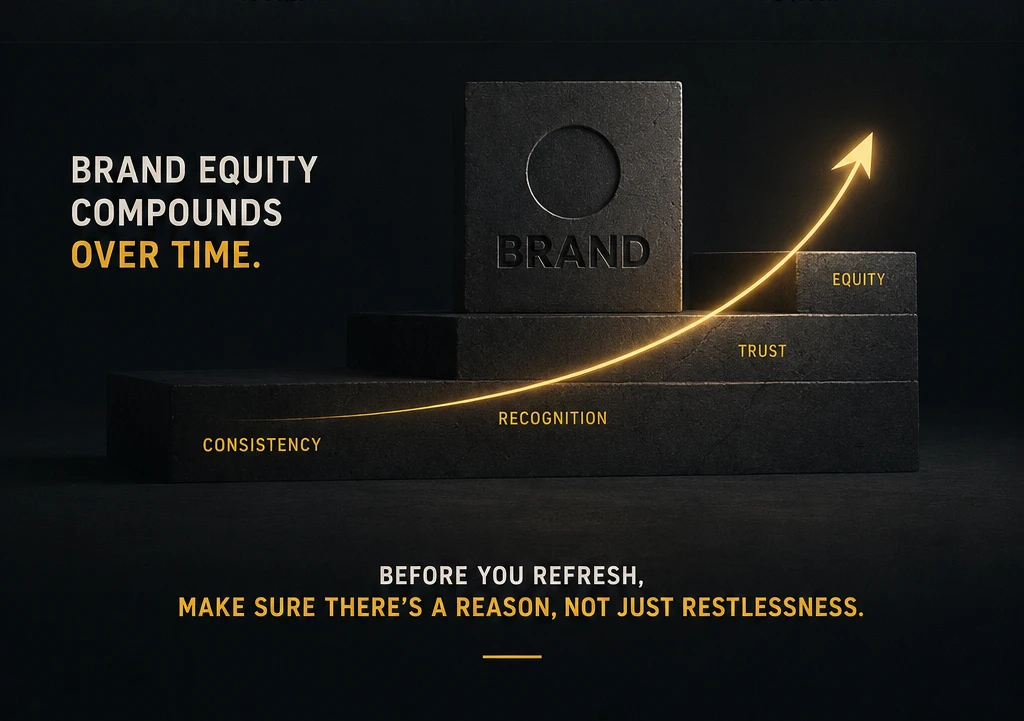
Brand equity isn't built in a single campaign. It's built through repetition, the same mark, the same voice, the same visual logic, showing up in the same recognizable way across hundreds of small touchpoints over years. That repetition is what allows a logo to become a shortcut in someone's brain, what allows a color to become synonymous with a company before a single word is read.
Every time a brand resets that identity, it resets the clock on recognition. Not entirely, strong brand architecture can carry equity through a redesign, but partially, and more often than most companies want to admit. If you're refreshing every twelve to eighteen months, you are, by definition, never letting any single identity accumulate enough repetition to do the job it exists to do.
This is the part that gets lost in the excitement of a new deck of brand guidelines: consistency isn't the boring, unambitious cousin of creativity. Consistency is the mechanism through which creativity actually pays off. A distinctive idea, given enough time in market, becomes recognition. Recognition becomes trust. Trust becomes the thing that lets a customer choose you without having to think about it. Cut that cycle short, and you never get past step one.
Why the Cycle Shrank
A few forces are compressing rebrand timelines, and none of them are really about strategy.
The first is visibility. Social platforms have made every brand's design choices instantly comparable to every other brand's, in real time, all the time. A visual identity that felt fresh two years ago can suddenly feel stale next to a competitor's TikTok-native rebrand, not because it's actually failing to do its job, but because the reference points shifted underneath it. Discovery now happens visually and quickly, on short-form video and social feeds, and that changes how "current" a brand needs to feel to register at all.
The second is internal restlessness. New marketing leadership arrives and wants to leave a mark. A rebrand is a visible, fundable, presentable project, it produces before-and-after slides that are much easier to sell up the chain than the slower, less glamorous work of actually building equity in what already exists.
The third is the sheer availability of execution. Design tools have gotten faster and cheaper, and AI has compressed what used to be months of exploration into days. When producing a new identity is this easy, the barrier that used to force restraint, cost, time, effort, simply isn't there anymore. Easy to do isn't the same as worth doing, but it's tempting to conflate the two.
None of these forces are inherently bad. Visibility, ambition, and better tools are all fine things. The problem is what happens when they're allowed to set the rebrand calendar instead of actual strategic need.
The Difference Between a Refresh and a Reason
This isn't an argument against ever touching your brand. Identities do need to evolve, markets shift, companies grow into new positioning, some marks genuinely do age badly. The audits worth doing are the ones that ask real questions: has our positioning changed? Has our market changed? Is there a specific business reason this identity no longer represents what we do? Not: does this still look modern enough for this quarter.
A partial refresh, scoped tightly and tied to something specific, is often the right call and doesn't require blowing up the whole system. A full identity overhaul should be reserved for moments that actually justify resetting the recognition clock, a genuine pivot, not a mood.
The agencies that serve their clients well in this environment aren't the ones saying yes to every "let's just refresh it" instinct. They're the ones asking the harder question first: what, specifically, changed that makes the current identity wrong? If there's no good answer, the right move isn't a new logo. It's patience, and the discipline to let what you've already built keep compounding.
Where This Leaves Brands
Speed is not a strategy. Neither is looking busy. The brands that will still mean something in ten years won't be the ones who refreshed the most, they'll be the ones who picked an identity worth defending and had the discipline to let it actually work.
That's a harder sell than a new logo. It's also the only version of this that builds something that lasts.