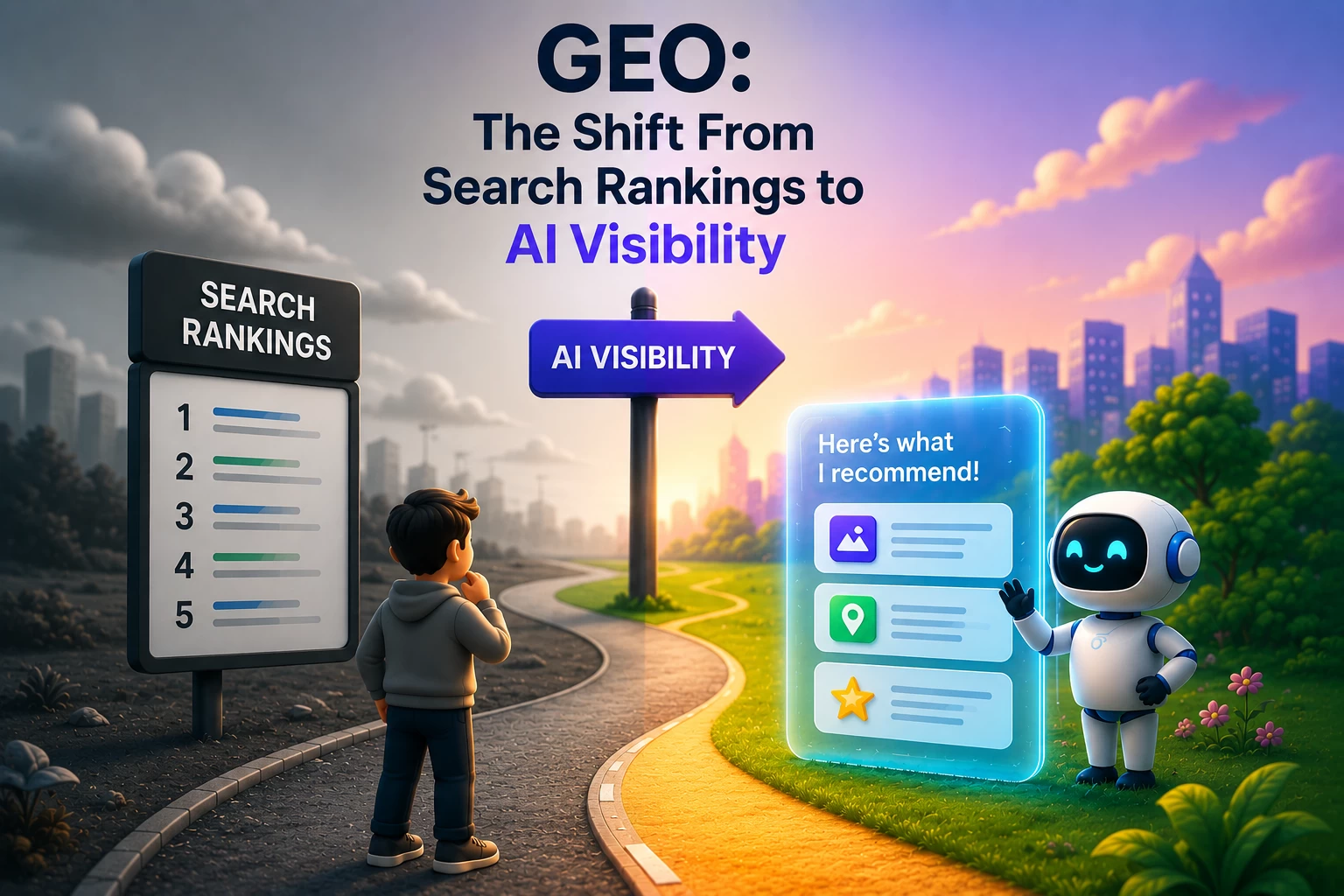
GEO: The Shift From Search Rankings to AI Visibility
Search isn't dying. But the way people search already has.
For twenty years, being found online meant one thing: rank on Google. Optimize the keywords, build the backlinks, win the click. That game isn't dead, but it's no longer the only game, and most brands haven't noticed the new one has already started.
Search is being rewritten from the inside. People aren't just typing queries into a search bar anymore, they're asking AI assistants questions directly, and getting answers, not links. ChatGPT, Gemini, Perplexity, Google's AI Overviews: they're not sending users to ten blue links. They're synthesizing an answer and naming a handful of sources, brands, or products inside it. If your brand isn't one of the names in that answer, you didn't just lose a click. You never existed in that conversation at all.
This is the discipline now being called Generative Engine Optimization, or GEO. And it's not SEO with a new coat of paint. It's a fundamentally different problem, and most agencies are still trying to solve it with old tools.
Why This Isn't Just a Technical SEO Problem
SEO rewarded structure: the right keyword density, the right headers, the right backlink profile. You could win by being technically correct.
GEO doesn't work that way. AI engines aren't crawling your page for keyword placement, they're trying to understand what you stand for, what you're actually good at, and whether you're a credible thing to mention. That's not a technical question. That's a brand question.
Here's the uncomfortable part for a lot of companies: AI engines summarize confident, distinct brands accurately, and they summarize vague, generic brands badly, or not at all. If your website copy could be swapped with a competitor's and nobody would notice, an AI trying to summarize "who you are" has nothing to grab onto. It'll either get you wrong or leave you out.
Meanwhile, brands with a sharp, consistent point of view, a clear stance on what they do, who they're for, and why it matters, give these systems something to actually quote. Clarity isn't just good branding anymore. It's now a technical requirement for being visible in the tools an increasing number of people use to make decisions.
The Businesses Already Feeling This
Any brand living or dying by "getting found" is exposed here: professional services, healthcare, hospitality, B2B software, real estate, anyone whose customers now ask an AI assistant "who's the best X for Y" before they ever type it into Google. If you've spent years building SEO authority and none of it addresses how an AI model perceives your brand identity, not your metadata, your identity, you're optimizing for a channel that's shrinking in relative importance. This doesn't mean SEO is obsolete. It means SEO is now table stakes, and brand clarity is the new competitive layer sitting on top of it.
What Actually Needs to Change
Most companies' instinct will be to treat this as an engineering task, structured data, schema markup, technical fixes to help AI crawlers parse a page. Those things matter. But they're solving for discoverability, not for what gets said about you once you're discovered.
The deeper fix is upstream of any of that: does your brand actually say something specific? Can someone, human or AI, read your positioning and come away with a clear, one-sentence understanding of what makes you different? If your "About Us" page reads like every other agency's About Us page, no amount of schema markup fixes that. The AI has nothing distinctive to repeat.
This is where brand strategy stops being a "nice to have" and becomes genuinely load-bearing infrastructure for visibility. Not decoration. Infrastructure.
The Agencies Who'll Win This Are the Ones Who Already Do This Well
There's a certain irony here. The industry spent the last few years treating brand strategy and performance marketing as separate disciplines, one for "feel," one for "results." GEO collapses that distinction. A vague brand with excellent technical SEO is now vulnerable in a way it's never been before. A distinct brand with a clear point of view has a structural advantage that has nothing to do with backlinks.
We'd argue this was always true, that clear brand thinking has always been the foundation good marketing sits on top of, but for the first time, it's provable in a very literal way. Ask an AI assistant to describe a business you know well, one with a genuinely sharp identity, and it'll usually get it right. Ask about a business with a muddled one, and watch the answer wobble.
Where This Is Actually Heading
We're not going to pretend we have a specific number for how much AI-referral traffic is shifting month over month, that's a stat worth checking against current reporting before anyone quotes it, and it's moving fast enough that any number gets stale quickly. What's not moving fast, and what we're confident calling now: the brands treating this as a copywriting tweak are going to lose to the brands treating it as an identity problem.
The businesses that show up clearly inside an AI-generated answer six months from now won't be the ones who reverse-engineered the algorithm. They'll be the ones who already knew exactly who they were before anyone had to ask.